



Complete Astronomical Guide
1. Overview: What Makes 2026 Special?
The year 2026 contains four eclipses in total:
2 Solar Eclipses
2 Lunar Eclipses
These occur in two distinct eclipse seasons, each season producing:
one solar eclipse
followed by one lunar eclipse about two weeks later
This pairing happens because eclipses only occur when the Sun is close to the Moon’s orbital nodes, a condition that repeats roughly every six months.
2. Eclipse Calendar 2026 – Quick Reference
In the year 2026, there will be a total of four eclipses, including two solar eclipses and two lunar eclipses.
On 17 February 2026, an Annular Solar Eclipse will occur.
On 3 March 2026, there will be a Total Lunar Eclipse.
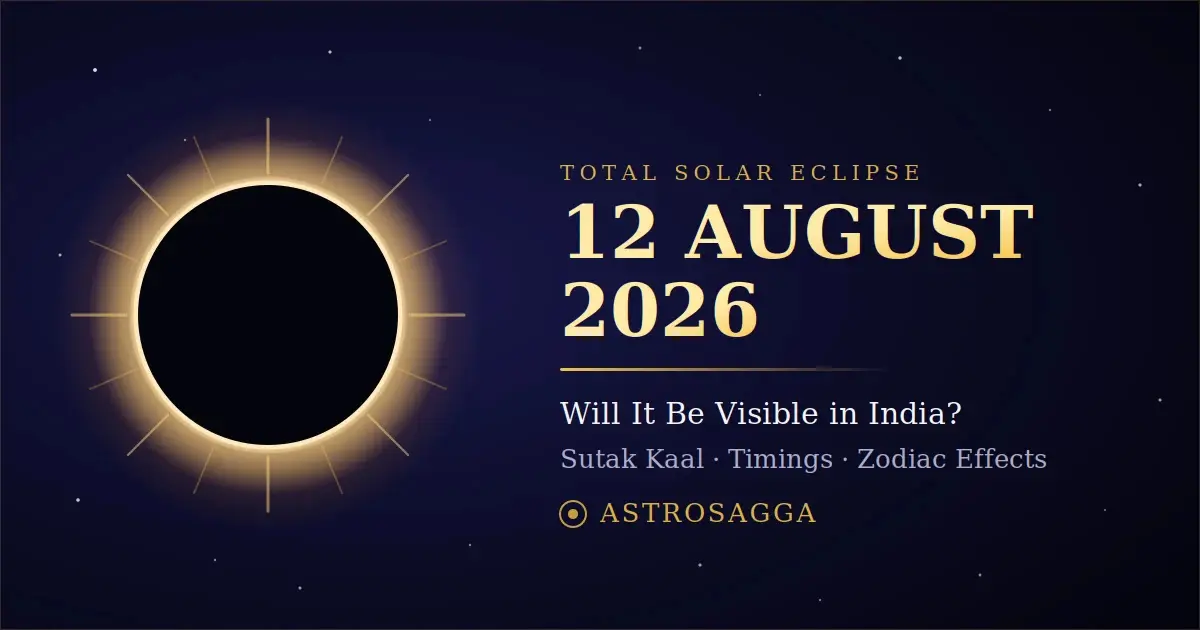
On 12 August 2026, a Total Solar Eclipse will take place.
On 28 August 2026, a Partial Lunar Eclipse will occur.
This eclipse calendar serves as a quick reference and is considered important for astrology and future planning.
3. Eclipse Mechanics (Explained Simply but Precisely)
Solar Eclipse (New Moon)
A solar eclipse occurs when:
the Moon passes between Earth and the Sun
casting its shadow on Earth
Types:
Total: Sun fully blocked
Annular: Moon is farther from Earth → appears smaller → bright ring remains
Partial: Sun partly covered
Lunar Eclipse (Full Moon)
A lunar eclipse occurs when:
Earth comes between the Sun and the Moon
Earth’s shadow falls on the Moon
Types:
Total: Moon fully enters Earth’s umbra
Partial: Only part of Moon enters umbra
Penumbral: Subtle shading only
4. First Eclipse Season (February–March 2026)
A. Annular Solar Eclipse — 17 February 2026
Why annular?
Because the Moon is near its apogee (farther from Earth), it cannot completely cover the Sun.
Global characteristics
Central “ring of fire” visible along a narrow path
Partial eclipse visible in surrounding regions
Astronomical timing (global maximum)
Maximum eclipse: 12:12 UTC
This is a daytime eclipse for Africa and surrounding oceans
Scientific importance
Used to study solar limb darkening
Shadow geometry differs from total eclipses (antumbra instead of umbra)
B. Total Lunar Eclipse — 3 March 2026
This is the only total lunar eclipse of 2026.
Key features
Entire Moon enters Earth’s umbral shadow
Totality duration: ~58 minutes
Moon appears deep copper-red due to atmospheric scattering
Eclipse phase sequence
Penumbral shading begins
Partial eclipse starts (curved shadow visible)
Totality (Moon fully red)
Shadow gradually recedes
Why lunar eclipses are easier to observe
Visible from anywhere Earth is experiencing night
No eye protection required
Long duration allows extended observation
5. Second Eclipse Season (August 2026)
A. Total Solar Eclipse — 12 August 2026
This is the most scientifically and visually significant event of 2026.
Path of totality
Greenland
Iceland
Spain (including mainland)
small region of Portugal
Outside this path, only a partial solar eclipse is visible.
Maximum eclipse
Occurs at approximately 17:46 UTC
During totality
Solar corona becomes visible
Daylight drops dramatically
Temperature decreases briefly
Stars and planets may appear
Critical safety rule
Eye protection is mandatory except during full totality
Partial phases can permanently damage eyesight
B. Partial Lunar Eclipse — 28 August 2026
This eclipse occurs just 16 days after the August solar eclipse.
Characteristics
Nearly 96% of the Moon’s surface darkened
Not total, but visually dramatic
Clearly visible shadow bite
Why it matters
Demonstrates deep umbral entry without full immersion
Excellent for photography and public observation
6. Eclipse Season Pattern (Structural Overview)
There are two main eclipse seasons during the year.
The first eclipse season occurs in February–March. During this period, an annular solar eclipse is followed by a total lunar eclipse, with a gap of approximately 14 days between them.
The second eclipse season takes place in August. In this season, a total solar eclipse is followed by a partial lunar eclipse, with a gap of around 16 days between the two events.
This pattern shows how solar and lunar eclipses usually occur in pairs within a short time span during each eclipse season.
This pattern confirms standard eclipse-season dynamics governed by orbital node alignment.
7. Scientific Value of 2026 Eclipses
Solar eclipses help study:
solar corona
solar magnetic fields
atmospheric ionization changes
Lunar eclipses help study:
Earth’s atmospheric composition
long-term climate trends (via eclipse darkness index)
Final Logical Conclusion
From a purely astronomical standpoint:
2026 contains four eclipses across two eclipse seasons
It includes:
one annular solar eclipse
one total solar eclipse
one total lunar eclipse
one deep partial lunar eclipse
The August 12 total solar eclipse is the most significant event, with totality crossing populated regions of Europe.
The March 3 total lunar eclipse offers the best globally accessible observation opportunity.
All eclipse events in 2026 follow predictable orbital mechanics, node alignment, and Saros-cycle evolution—making 2026 a clean textbook year for eclipse study, observation, and public education.